
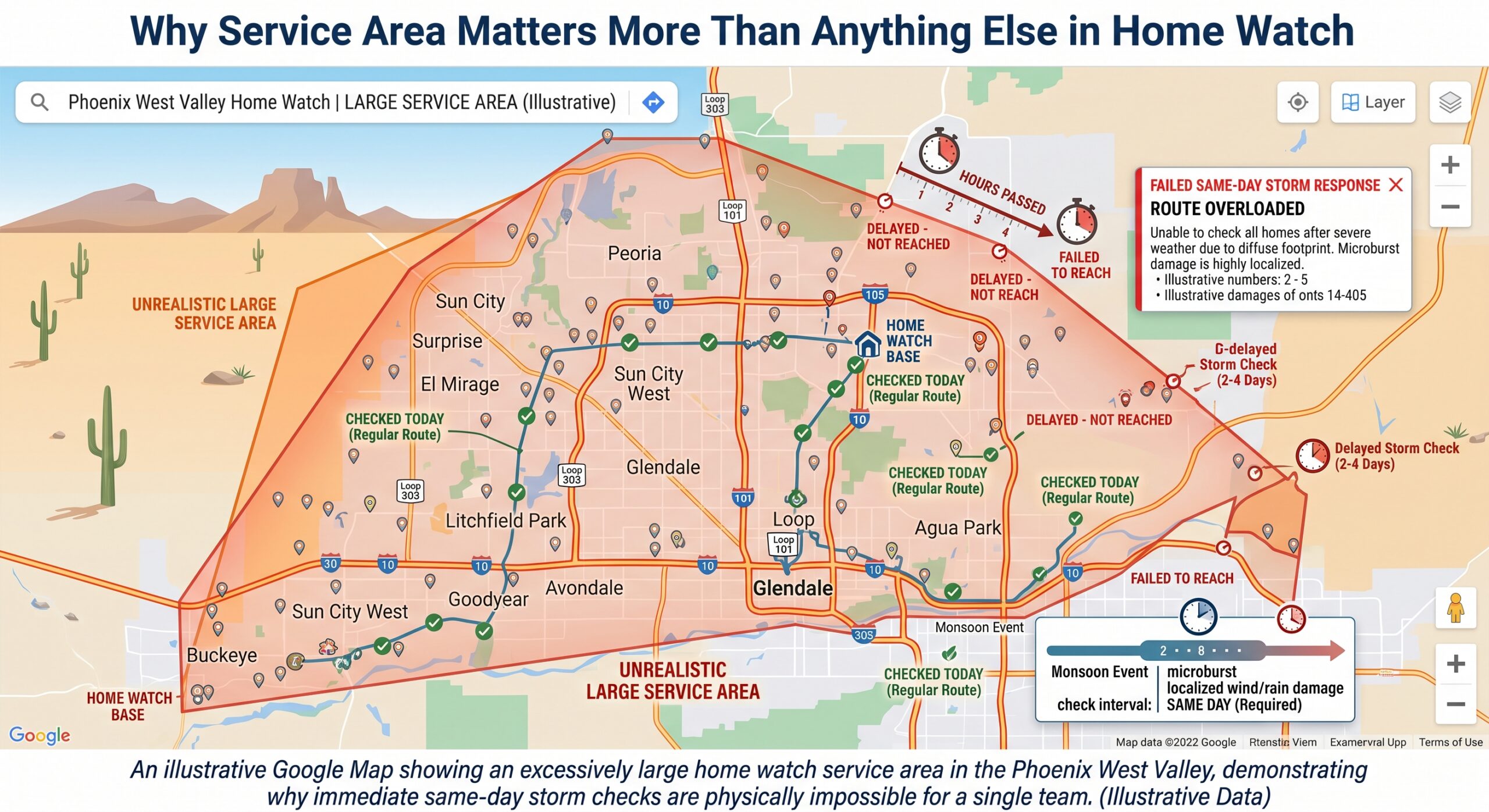
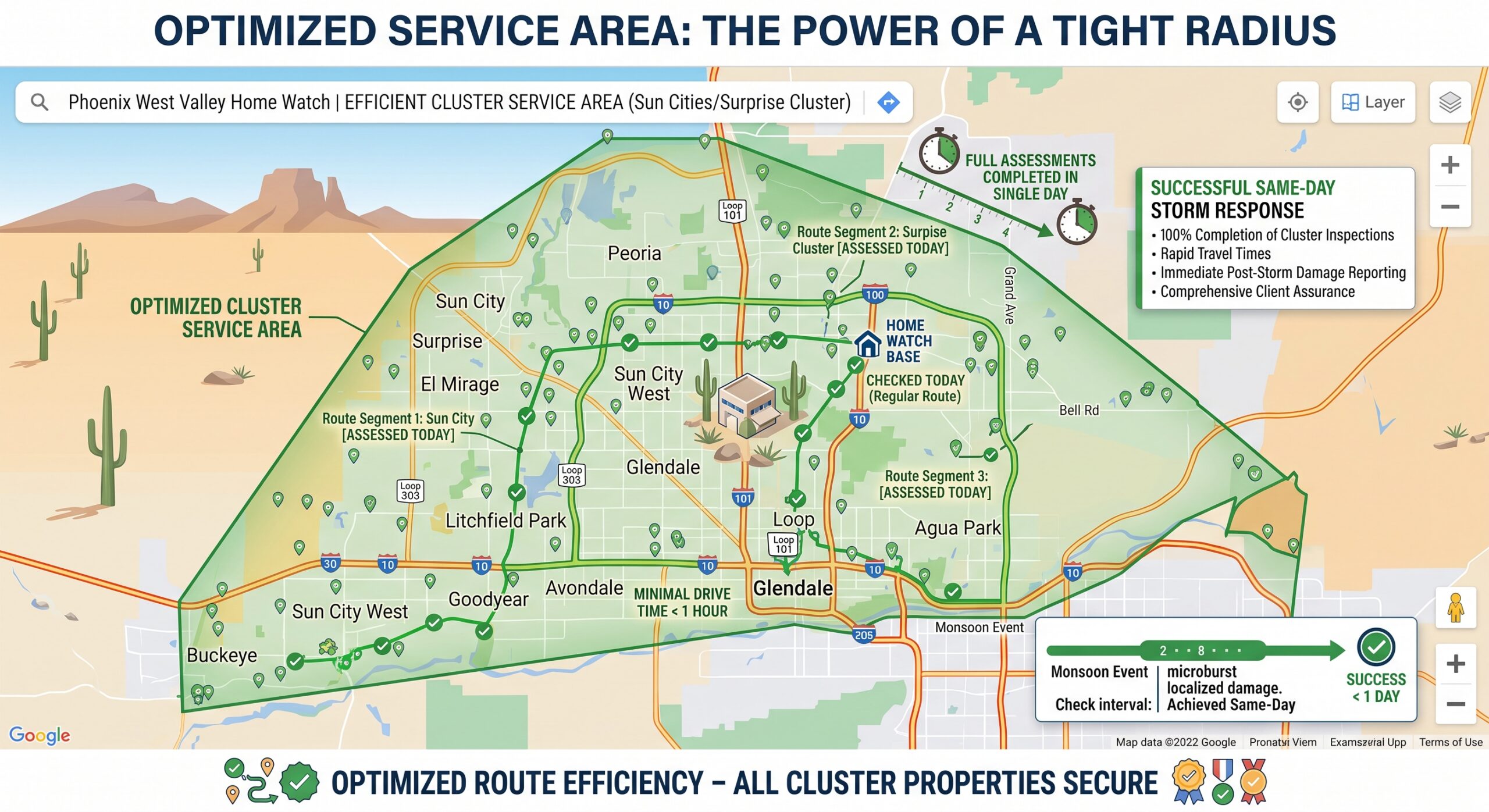
Quick answer: Service radius is the factor that decides how fast a home watch company can reach a property after a storm. A thorough visit takes 30 to 45 minutes, so a company spread across 40 miles of the Valley physically cannot check every client on the same day severe weather hits. A tight radius covering a few neighboring communities is what makes same day storm response possible.
Arizona’s monsoon runs from June 15 through September 30, with peak activity in mid July through August. A single cell can cross the West Valley in about twenty minutes and leave behind gusts that routinely reach 60 mph, with microbursts capable of 100 mph or more in the worst cases. Tiles slide off roofs. Patio covers and pool cages tear loose. Irrigation lines break and run unnoticed for days. Power drops, the air conditioner stops, and the inside of a closed house climbs past 100 degrees while the refrigerator quietly thaws.
What separates monsoon damage from almost every other risk to a seasonal home is how localized it is. Microbursts are typically less than 2.5 miles across, so one street can take real damage while homes a mile away see nothing but wind and dust. Nobody can look at a radar loop the next morning and know which houses need attention. Every home in the path needs eyes on it that day, not on the next scheduled rotation.
This is the question almost nobody asks before handing over a key, and the answer is arithmetic rather than marketing. A real interior and exterior inspection takes 30 to 45 minutes at the property. Drive time between West Valley communities adds up fast after a storm, when signals are dark and streets are flooded or blocked by debris.
The table below uses round numbers to show the shape of the problem. The figures are illustrative, not a description of any particular company.
| Coverage model | Homes on the list | Distance between the two farthest homes | Realistic time to check every home after severe weather |
|---|---|---|---|
| Tight radius, a few neighboring communities | About 40 | 5 to 10 miles | Same day |
| Regional, half the West Valley | About 60 | 20 to 25 miles | One to two days |
| Valley wide, Buckeye to Peoria to Sun City West | About 90 | 35 to 40 miles | Two to four days |
Once the route stretches past what a single day allows, someone has to decide which clients get checked first and which ones wait. That decision happens quietly and the homeowner never sees it. A property might be perfectly fine. It might also have a broken skylight with rain running onto the living room floor for three days before anyone opens the door.
A broad service area reads as strength in an advertisement. During monsoon season it is often the weak point, because water sitting inside a closed house does not pause while the route catches up. Insurance carriers also tend to look closely at how long damage went unaddressed, which makes response time as important as the inspection itself.
| Factor | Wide coverage area | Tight coverage area |
|---|---|---|
| Storm response | Clients triaged over several days | Every home reached the same day |
| Local knowledge | General familiarity with the region | Knows normal roof lines, common builders, and typical failure points street by street |
| Emergency access | Long drive to meet a plumber or roofer | Able to meet a contractor on short notice |
| Schedule reliability | Traffic and distance push visits around | Visits stay predictable through the season |
| Trade relationships | Broad vendor list | Working relationships with trades already serving those communities |
Proximity also changes what gets caught. Someone who inspects dozens of homes in the same builder tract recognizes when a roof tile pattern looks wrong from the driveway, when a patch of green in the gravel means a broken drip line, or which floor plans put the water heater in the garage where a leak runs toward the house. That kind of pattern recognition only comes from repetition inside a small area.
The West Valley makes this harder than it looks on a map. The retirement and golf communities along the 303 corridor are clustered fairly close together, but the region as a whole stretches roughly 25 to 30 miles from Buckeye to north Peoria. A company advertising the whole footprint is describing a coverage map, not a response plan.
Four questions surface the answer quickly. A company that has thought carefully about coverage will answer all four in about a minute. A company that has not will change the subject to how much they care.
That last question matters more than it sounds. A report built from GPS stamped photos shows exactly when someone stood at the property. A written summary with no photos proves nothing about timing, which is precisely the detail an adjuster asks about later. Additional screening questions are covered in this guide on how to vet a home watch company in Arizona.
Sometimes, though it trades one problem for another. A house sitter or home sitter usually lives in the home, so response time is immediate, but coverage depends entirely on one person being present and knowing what a developing problem looks like. Home watch works the opposite way, inspecting a seasonal home on a set schedule and documenting its condition every time. Property watch and vacant home coverage through a licensed and insured company also carries liability protection that a neighbor with a key does not. The tradeoffs are laid out in this comparison of home watch, house sitting, and property management.
Most seasonal homes in the West Valley sit closed for four to six months, and that window happens to cover the hottest stretch of the year and the most violent weather Arizona produces. Nothing about it is gentle on a building. Drain traps evaporate and let sewer gas into the house. Scorpions and roof rats look for cool interior space. Pool chemistry drifts and the surface turns before anyone notices. Roof underlayment that survived ten summers finally gives up during a storm nobody was there to see.
None of that can be prevented outright, and any company promising otherwise is overselling. What a well run home watch service can do is shorten the gap between the moment something breaks and the moment someone finds it. That gap is where small problems become large claims, and its length is decided almost entirely by how far away the person with the key happens to be. A published home watch check list is a reasonable way to compare what different companies actually inspect on each visit.
There is no official standard, but a radius that allows every client to be reached within a single day is the practical benchmark. In the West Valley that usually means a cluster of neighboring communities rather than the entire region. Asking for the radius in miles is the fastest way to find out.
The same day, or the following morning at the latest for storms that arrive late at night. Water intrusion and a failed air conditioner both cause escalating damage by the hour in an Arizona summer. Any answer measured in days is worth questioning.
Not necessarily. A large coverage map can also mean a company is adding clients faster than its route can absorb. The more useful measure is how many homes are on the list and how tightly they are clustered.
No. A patrol looks at the outside of a home from the street, while home watch includes a documented interior inspection on a set schedule. Problems such as a leaking water heater, a stopped air conditioner, or a dry drain trap are invisible from the curb.
Many owners move to weekly visits for the summer, since June through September combines extreme heat with storm risk. Monthly visits still catch slow developing problems but leave a longer window between a storm and an inspection. The right interval depends on the home, the pool, and the owner’s insurance requirements.
