
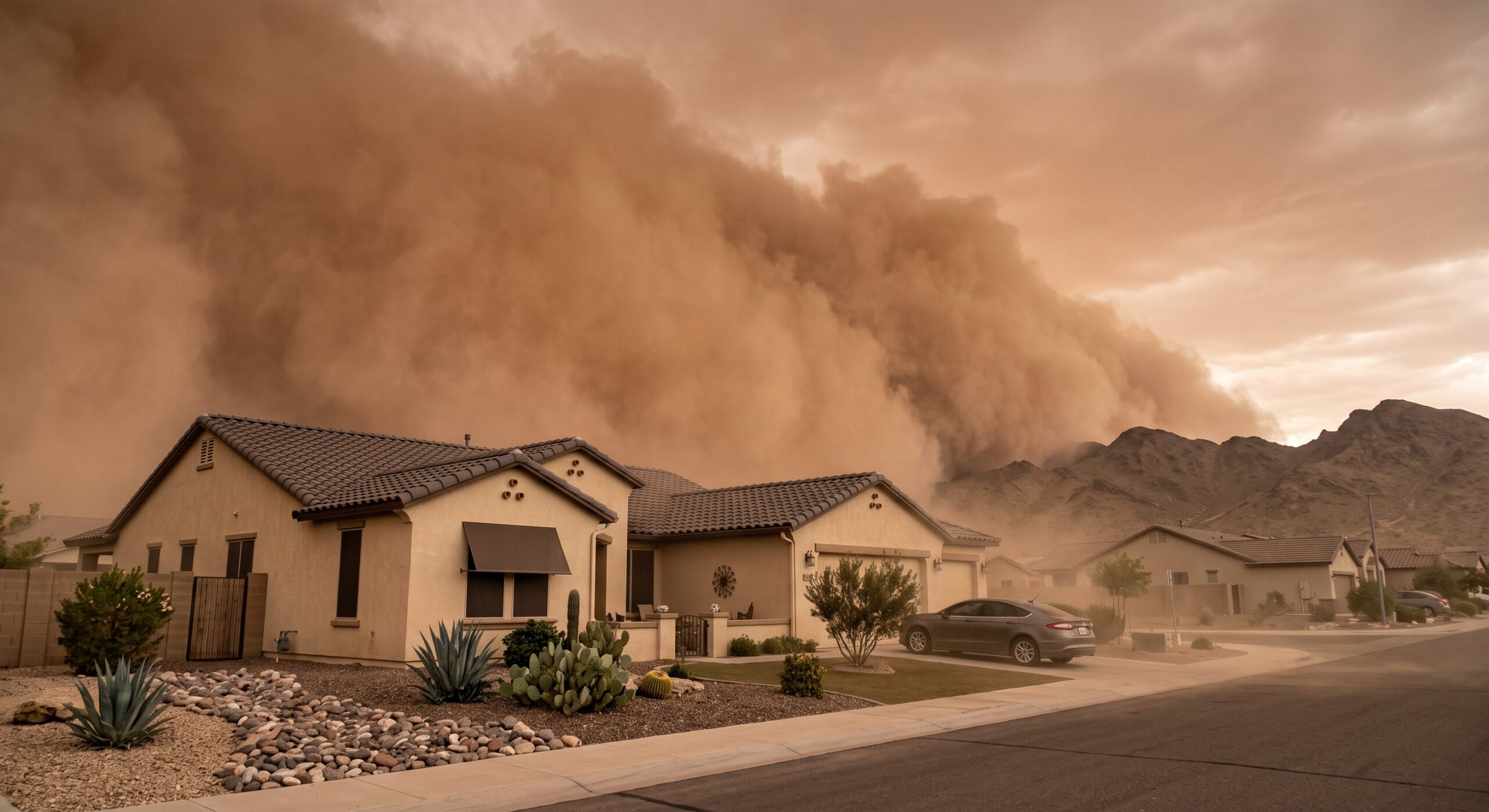
Quick answer: Yes. Any storm that produces gusts above roughly 50 mph, hail, or heavy rain over an empty home warrants a same day or next morning inspection. Water that enters through a lifted tile or a damaged vent can begin growing mold in 24 to 48 hours, and most homeowner policies require the owner to take prompt steps to prevent further damage once a loss occurs.
An occupied home reports its own problems. Someone hears the wind take a section of fascia, notices the ceiling stain the next morning, or walks out to find pool deck furniture in the neighbor’s yard. A closed seasonal home reports nothing at all. The damage happens, the storm passes, and the house sits quietly with whatever came in through the opening.
Arizona summers make that silence expensive. A microburst can lift roof tiles without breaking a single one, leaving the underlayment exposed in a way that is completely invisible from the street. The next storm two weeks later drives rain straight into the gap. By the time anyone opens the door, drywall is soft, insulation is saturated, and the repair has moved from a roofer’s afternoon to a restoration project. The storm did not cause most of that cost. The delay did.
Not every rain event needs a visit. The useful threshold is whether the storm produced conditions capable of moving something on the house. The table below covers the events that typically warrant a look.
| Storm condition | Why it warrants a check | What it commonly damages |
|---|---|---|
| Gusts above 50 mph | Enough force to lift tiles and shingles | Roof tiles, fascia, patio covers, pool cages, block walls |
| Microburst or downburst nearby | Localized wind that can exceed 100 mph in a band under 2.5 miles wide | Roofs, trees, gates, anything not anchored |
| Hail of any size | Damage to roofing is often invisible from the ground | Roof surface, gutters, stucco, exterior paint, skylights |
| Heavy rain over an hour | Water finds vents, soffits, and window seals | Interior ceilings and walls, garage, exterior drainage |
| Dust storm or haboob | Fine silica works into gaps and equipment | Air conditioner condensers, pool equipment, window tracks, filters |
| Extended power outage | Cooling and refrigeration stop | Interior temperature, refrigerator contents, pool pump cycles |
The last row gets overlooked. A power outage that lasts several hours in July can push the inside of a closed house past 100 degrees, which stresses electronics, warps candles and vinyl, and can cause a refrigerator to thaw and leak onto the floor. A storm can damage a home without touching the roof at all.

This is where the timing argument lives. The following is a general picture of how a small water intrusion tends to develop in Arizona summer conditions.
| Time since the storm | Typical condition | Practical outcome |
|---|---|---|
| First 24 hours | Water present, materials still drying | Often a dry out and a roof repair |
| 24 to 48 hours | Mold can begin developing on damp surfaces | Remediation may be added to the repair |
| 3 to 7 days | Drywall and baseboard absorb, insulation stays wet | Materials removed rather than dried |
| 2 weeks or longer | Odor, staining, and possible framing or flooring involvement | Larger project, and the carrier may question the delay |
None of that is a guarantee, since much depends on how much water entered and where. The pattern holds anyway. The cost curve on water damage is steep at the beginning and flat later, which means the value of an inspection is concentrated in the first day or two.
A storm check is not the same as a routine visit. It is targeted at what wind and water do, and it usually includes:
That last item does more work than it appears to. Photos taken the day after a specific storm, with time and location attached, establish that damage existed on a particular date. Carriers routinely attribute roof damage on older homes to normal wear rather than a weather event, and a dated set of images taken before and after is one of the few things that pushes back on that. A published home watch check list shows what a routine visit covers and makes it easier to see where a storm check adds to it.
Most homeowner policies contain a duties after loss clause requiring the owner to report a loss promptly and to take reasonable steps to prevent additional damage. Many carriers read prompt as somewhere in the range of 30 to 60 days, and Arizona policies commonly shorten the deadline for filing suit to one year from the date of loss. Those are two different clocks and neither one starts running conveniently for someone sitting in Minnesota in August.
Vacancy language adds another layer. Most homeowner policies restrict or exclude certain coverage when a property sits unoccupied beyond a set period, often 30 to 60 consecutive days, which describes nearly every seasonal home in the West Valley during the summer. Some carriers treat a furnished second home differently from a truly vacant one, and some will accept documented periodic inspections as evidence the property was being monitored. It is worth calling the agent and asking directly how the policy treats a home that sits closed from May to October, and whether a vacant home watch arrangement changes anything on their end. The answer varies by carrier and it is better to learn it in March than in a claim.
Practices differ across the West Valley market. Some companies fold storm response into the monthly plan, some include the first storm visit each month and charge a flat rate beyond that, and some treat every unscheduled visit as an extra billed at their standard rate, which generally runs somewhere in the neighborhood of $20 to $30 per visit depending on the size of the home and what the visit includes.
The number matters less than knowing it in advance. A homeowner who does not know the storm policy is likely to hesitate before requesting a check, and hesitation is the expensive part. Worth asking before signing: is storm response automatic or does it require a phone call, and what does the company consider a storm worth responding to.
There are workable options, though each has a real limitation. A neighbor who stays through the summer can walk the exterior, but is unlikely to check a water heater closet or read a thermostat, and asking a friend to enter a home creates a liability question nobody enjoys discussing later. A house sitter or home sitter who lives in the property has the fastest possible response time but a much higher cost for a five month absence. Cameras and water sensors help a great deal and cost very little, though they only report what they are pointed at and they depend on power and internet staying up, which is exactly what a storm takes down first.
Whatever the arrangement, the pieces to settle before leaving are the same. Someone local needs a key and permission to enter, that person needs to know what the house looks like normally, and the owner needs a way to authorize a repair from out of state. Working through a departure guide before the drive north is the simplest way to make sure none of that gets left undecided.
The same day when possible, or the following morning for storms that arrive overnight. Water intrusion and a stopped air conditioner both worsen by the hour in an Arizona summer. Waiting for the next scheduled visit is what turns a repair into a claim.
It depends on the company. Some include the first storm visit each month at no additional cost and charge a flat rate for additional ones, while others bill every unscheduled visit separately. Asking how storm response is handled and billed should happen before signing an agreement.
Yes. Wind can lift tiles and set them back down slightly out of position, leaving the underlayment exposed while the roof looks normal from the ground. That kind of damage typically shows up as an interior leak weeks later during the next storm.
It can. Dated photos with location data help establish that damage existed on a particular date and that the property was being monitored, which matters when a carrier attributes damage to wear rather than a storm. It does not guarantee a claim outcome, and policy terms still control.
Not entirely. Cameras and water sensors are useful and inexpensive, but they only cover what they are aimed at and they stop working when power or internet goes down, which is common during the storms that cause damage. They work best alongside periodic in person inspections rather than instead of them.
